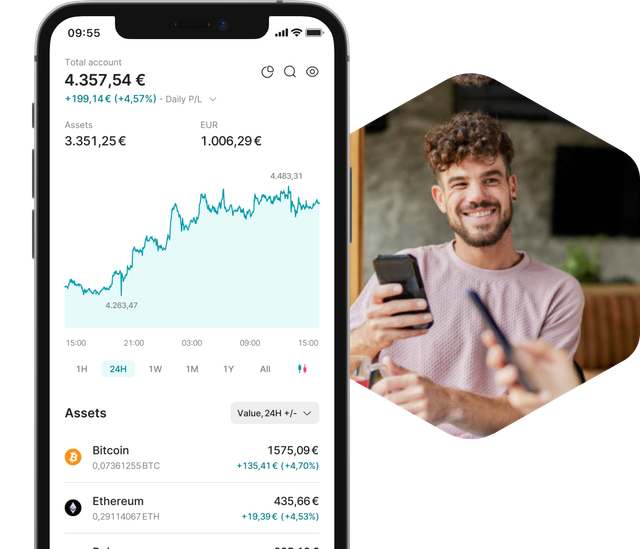
What is volatility in the crypto market?
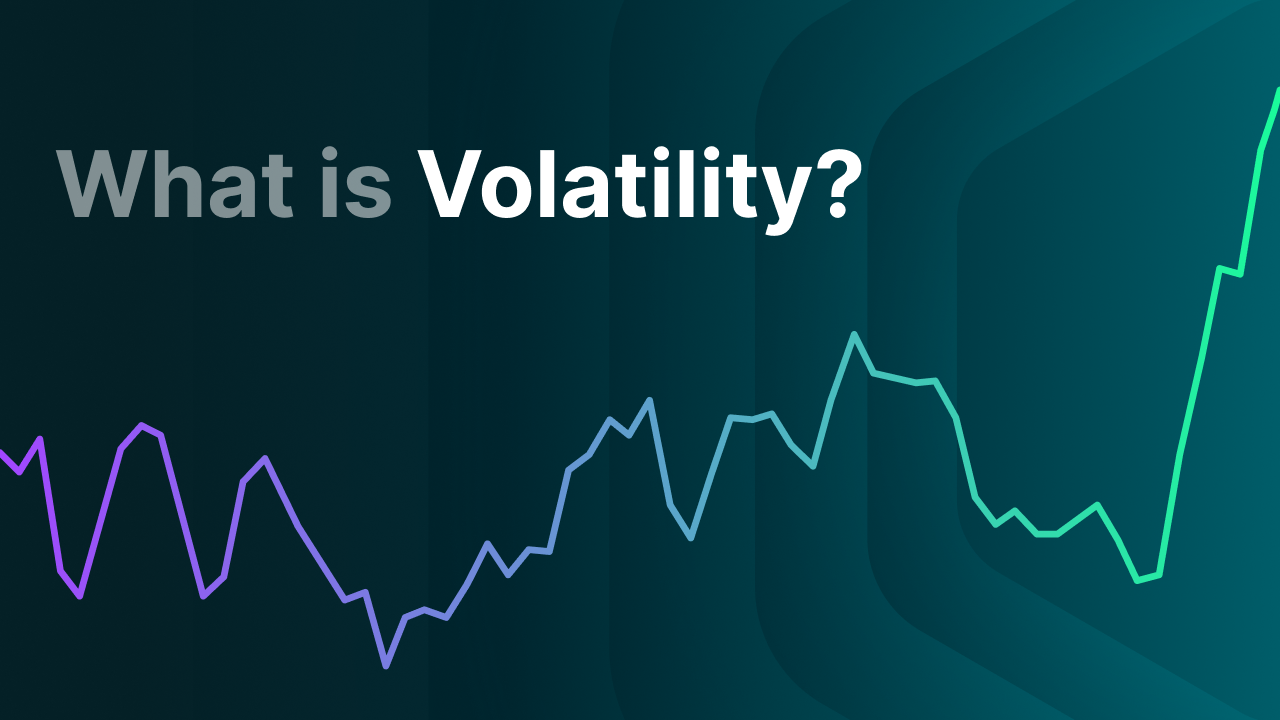
What is volatility?
Volatility shows how strongly the price of an asset (for example a stock or cryptocurrency) fluctuates within a certain period. It does not say anything about whether the price goes up or down, only how strong those movements are. If the price moves slowly and predictably, it has low volatility. When the price moves quickly and strongly, there is high volatility.
In financial markets, volatility is often used as a way to describe uncertainty. When there are stronger fluctuations, it becomes more difficult to predict future price movements. Volatility is therefore an important concept for people who invest in crypto or stocks.
Some investors see volatility as a risk, but it has two sides. Strong price fluctuations not only increase the chance of losses, but also of profits. Volatility is therefore not a judgment of whether an investment is good or bad, but a characteristic that says something about risk and potential return.
Key Takeaways
- Volatility describes how strongly the price of an asset fluctuates and says something about uncertainty, risk, and potential return.
- Crypto is perceived as more volatile than traditional markets, because price movements that are exceptional there are often considered normal within crypto.
- Volatility in crypto mainly arises from market sentiment, news, supply and demand, and differs per market phase.
- Smaller cryptocurrencies are generally more volatile than large coins due to lower liquidity and thinner order books.
- Volatility cannot be avoided, but with a clear strategy and risk management it can be managed.
Why volatility feels different in crypto
Volatility can sometimes feel different in the crypto market than in traditional financial markets. Where a price movement of a few percent is already noticeable in the stock market, such fluctuations are "normal" in crypto. What traditional investors see as volatile is often just noise for crypto investors.
That difference stems from the nature of the market. Compared to the stock market, crypto is a relatively young market, without decades of established structures and stable regulation. In addition, the crypto market is open 24 hours a day, worldwide, without closing times or natural pauses that slow down price movements. As a result, prices can continuously respond to news, sentiment, and changes in supply and demand.
Even large cryptocurrencies such as Bitcoin and Ethereum therefore remain relatively volatile. Although they have certainly become more stable over the years, daily movements of a few percent are still normal. With smaller or newer cryptocurrencies or tokens, the fluctuations can be much larger. Anyone who wants to compare crypto with traditional markets must therefore take into account a different standard for what is considered "normal".
How does volatility arise in crypto?
Although volatility in the crypto market is normal, there are several factors that fuel price fluctuations.
Market sentiment is an important factor. The crypto market is strongly driven by emotion, where fear, optimism, greed, and FOMO push investors to make quick decisions. These irrational actions can lead to sudden buying or selling waves. When many people move in the same direction at the same time, price movements are further amplified. Investors can use the Fear and Greed Index to determine market sentiment.
News also plays a major role. Announcements about regulation, hacks, partnerships, adoption by large companies, or technological updates can ignite the market in a short period of time.
Supply and demand are also crucial. Because many cryptocurrencies have a limited circulating supply, the price can rise explosively when demand increases rapidly. With selling pressure, the opposite happens. This effect is amplified with cryptocurrencies that have a low trading volume, where individual transactions have relatively large impact.
Finally, it is important to understand that volatility is not constant. The crypto market also experiences periods of relative calm, which are alternated with phases in which price movements increase sharply. Volatility often rises during market cycles such as bull or bear markets. In more sideways markets, price fluctuations are often smaller. Volatility therefore moves along with the phase the market is in.
How is volatility measured?
The volatility of an asset is usually measured by looking at historical price data, analyzing how much the price has deviated from the average over a certain period, for example 30 days or a year. The larger that deviation, the higher the volatility.
There are also models that attempt to predict volatility. They do this based on expectations and market data and form the basis for well known indicators such as volatility indexes in traditional markets. This always remains an estimate, because no one can predict with certainty how violently prices will move in the future.
What does volatility mean for crypto investors?
Volatility can have major consequences for some crypto investors. It not only determines the risk of an investment, but also how comfortable someone feels holding it.
For active day traders, volatility is often an essential part of their strategy. Without these price movements, there would be few opportunities to profit. For long term investors, also known as HODLers within crypto, it is different. They tend to look more at the underlying value and future potential of a project and usually ignore short term fluctuations.
Especially for beginning crypto investors, volatility can be extra challenging. Sharp price drops can lead to panic selling, while rapid increases can encourage FOMO and thus impulsive purchases. Crypto investors without a clear strategy therefore have a higher chance of making emotional decisions during volatile periods.
In practice, volatility is often less a technical problem than a behavioral one. How someone deals with strong price movements depends heavily on the chosen strategy and experience. With a clear plan, volatility can be seen as a normal part of the market. Without a strategy, it increases the chance of impulsive decisions, which can negatively affect returns.
Which cryptocurrencies are the most volatile?
The cryptocurrencies with the highest volatility are generally smaller crypto assets with a low market capitalization and limited trading volume. This is mainly because these markets are thinner: there are fewer buy and sell orders in the order book. When a relatively large purchase or sale then takes place, the price can be pushed up or down strongly immediately.
Large and established cryptocurrencies usually have a higher market capitalization and are traded much more intensively, resulting in more liquidity and a deeper order book. This makes these cryptocurrencies relatively less volatile, but not necessarily stable. Even large cryptocurrencies can still move quickly and strongly, especially during periods of market unrest or major news.
In addition, "most volatile" is always relative and dependent on market conditions. Smaller cryptocurrencies can also experience periods of calm, while larger coins can become more volatile during turbulent market phases.
How do you deal with volatility?
Because volatility is common in the crypto market, you cannot avoid it, but you can manage it. By making conscious choices about how and when you invest, you can better deal with price fluctuations and prevent emotions from taking over.
- Focus on the long term: Instead of reacting to all volatile price movements, many investors choose to focus on the long term and hold their crypto (HODLing). This means they do not have to worry as much about short term fluctuations.
- Invest periodically: By automatically investing at fixed moments, you reduce the risk of buying crypto at unfavorable times. This strategy is known as Dollar-Cost Averaging (DCA), where the impact of strong price movements is spread over time. At Finst, you can do this by using Auto-Invest.
- Diversify your portfolio: By spreading your investments across multiple types of cryptocurrencies and tokens, you limit the risk that one sharp price drop affects your entire portfolio.
- Only invest what you can afford to lose: Because volatility can lead to rapid and significant price drops, it is important to only invest amounts you can afford to lose without running into financial problems.
- Use stablecoins when needed: Stablecoins are designed to avoid volatility. Due to their peg to more stable assets such as fiat currency, they can help to temporarily reduce exposure to strong price fluctuations.
Will crypto volatility change in the future?
For some large cryptocurrencies, volatility appears to be gradually decreasing. Higher trading volumes, more liquidity, and increasing institutional participation contribute to a more stable market. Still, crypto as a whole remains volatile, especially compared to traditional financial markets.
For smaller projects and new tokens, volatility will likely remain a structural feature. Strong and sudden price movements are still very much part of that space.
Final thoughts
Volatility is a fundamental part of the crypto market and largely determines how prices behave. Although strong price fluctuations involve risks, they also create opportunities, depending on the strategy and experience of the investor. It is important not to judge crypto by the same standards as traditional markets, but to take into account a different frame of reference for what is considered normal. By understanding where volatility comes from and how it can change across different market phases, investors can better deal with uncertainty. With realistic expectations, a clear strategy, and appropriate risk management, volatility becomes less of an obstacle and more of a characteristic of the market.