What Are Maker and Taker Fees, and How Do They Affect Your Transaction Costs?
What Are Maker and Taker Fees?
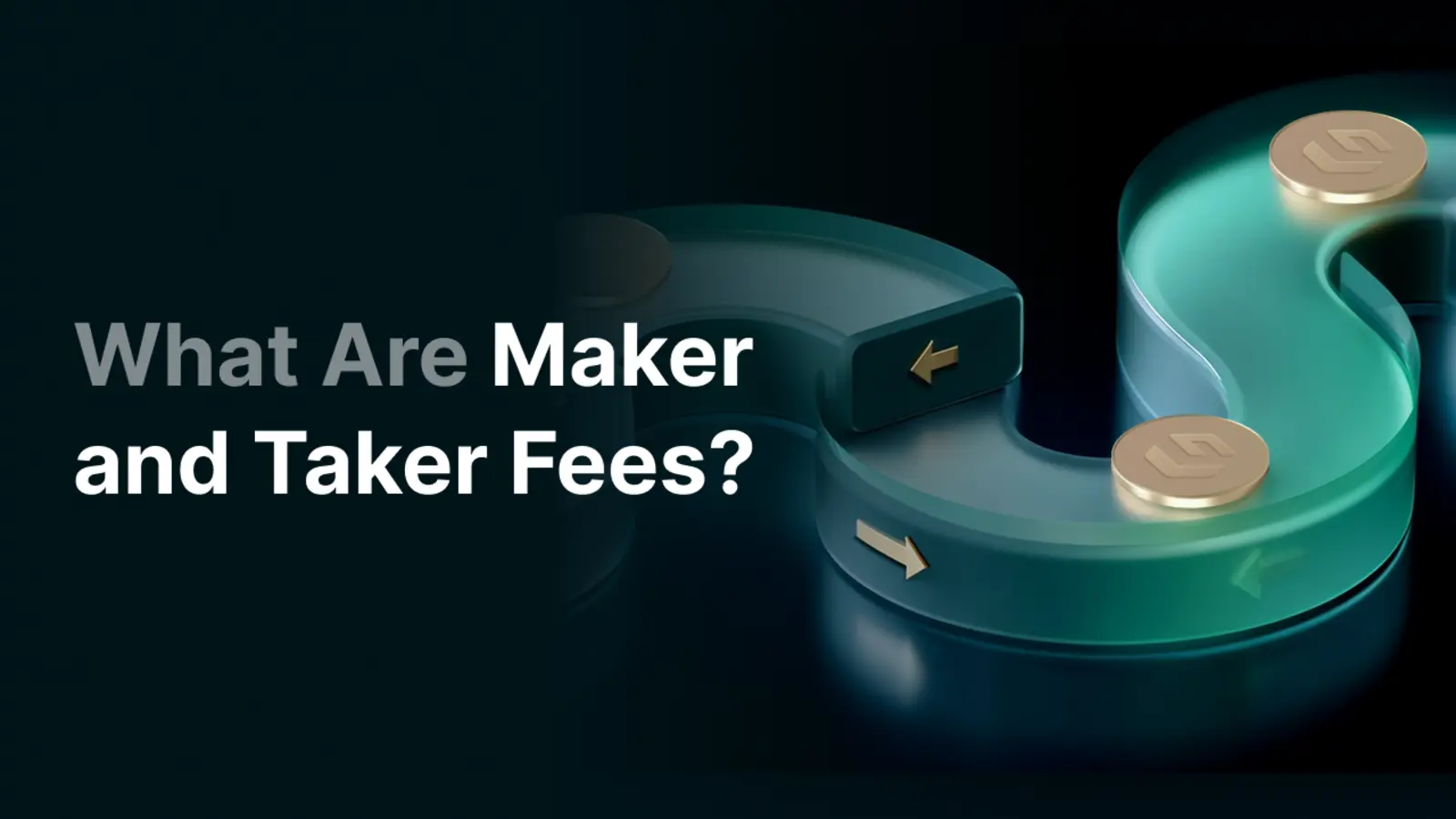
Maker and taker fees are trading costs on a crypto exchange with an order book, where the rate depends on how your order is executed. If you add a new buy or sell order to the order book, you’re a maker. If you buy or sell right away through an order that’s already there, you’re a taker.
You can think of an order book as an overview of open orders. On one side are people who want to buy crypto, and on the other side are people who want to sell. Those open orders create liquidity: there is supply and demand that other traders can act on right away.
Important to know: it’s not the order type you choose, but the actual execution that determines whether you’re a maker or taker. So a limit order is not automatically a maker order. If your limit price immediately matches an existing order, your order is executed right away and you pay taker fees.
It can even be both within one order. Part of it can be executed right away as a taker, while the rest stays in the order book. If that remaining part is executed later, the maker fee applies to it.
What Is a Maker?
A maker places an order that is not executed right away and therefore stays visible in the order book. That adds liquidity. In a way, you create a new offer that someone else can take later.
Say the current price of a token is €100 and you place a buy limit order at €98. As long as no one wants to sell for €98 right away, your order stays open. Then you’re a maker. If the exchange charges a maker fee of 0.20% and your order is later filled for a total of €1,000, you pay €2 in maker fees.
Many crypto exchanges charge makers a lower rate. That makes sense: open orders make the order book deeper and give other traders more choice.
Keep in mind: a lower maker fee does not guarantee that your order will be filled. The price may never reach your limit, or there may not be enough volume at that price level for your full order.
What Is a Taker?
A taker immediately executes an order that is already in the order book and therefore removes liquidity from it. You accept the best available price at that moment because you do not want to wait.
A market order is usually a taker order. That kind of order is meant to buy or sell right away at the available prices. A limit order can also be a taker. That happens, for example, when you set a buy limit so high that it immediately matches an existing sell order. If an exchange charges a taker fee of 0.35% and you buy €1,000 worth of crypto right away, you pay €3.50 in taker fees.
Speed is the big advantage of a taker order. The downside is that taker fees are higher on many order book exchanges than maker fees. If there are few orders in the order book, a market order can also be executed across multiple price levels. That is called slippage and is separate from the taker fee.
Key Takeaways
- Maker and taker fees are trading costs that depend on how an order is executed.
- A maker adds an open buy or sell order to the order book.
- A taker immediately executes an existing order and removes liquidity.
- A limit order can be maker or taker, depending on whether it matches right away.
- One order can be partly taker and partly maker when it is filled in pieces.
How Do Maker and Taker Fees Work on a Crypto Exchange?
On a crypto exchange with an order book, buy orders, also called bids, and sell orders, also called asks, are collected by price level. Orders that stay open add liquidity. Orders that trade against them right away remove liquidity.
For each execution, also called a fill, the exchange looks at exactly what happened. Does your order stay in the order book? Then it usually gets the maker rate. Does it match immediately with an existing order? Then the taker rate usually applies.
Example: You place an order for €1,000. Of that, €400 is executed right away at a taker fee of 0.35%. On that part, you pay €1.40 in trading costs. The remaining €600 stays in the order book and is later executed at a maker fee of 0.20%. On that, you pay €1.20. So in total, you pay €2.60 in maker and taker fees in this example.
Market orders are usually taker orders because they are executed immediately. With limit orders, it works differently. A limit order gives you a maximum buy price or minimum sell price, but it can be executable right away if your limit price hits an existing order.
Some exchanges have a post-only or maker-only option. That helps prevent your limit order from unexpectedly becoming a taker order. If the order could match right away, it gets canceled instead of executed. If it does stay in the order book, it acts as a maker. Whether this option is available depends on the exchange, market, and order type.
How Are Maker and Taker Fees Calculated?
You calculate maker and taker fees based on the trade value of the part of your order that was executed. Simply put: you multiply the transaction amount by the applicable percentage.
Say a crypto exchange charges a maker fee of 0.20% and a taker fee of 0.35%. For a maker order with a trade value of €1,000, you would pay €2 in trading costs. If the same €1,000 is executed as a taker, you would pay €3.50.
The calculation looks like this:
trade value × fee percentage = trading costs
For a partial fill, you calculate each part separately. For example, if €400 is executed right away at a taker fee of 0.35% and €600 is later executed as a maker at 0.20%, you pay €1.40 on the first part and €1.20 on the second part. That means one order can end up with different fee percentages.
The percentage can also depend on your fee tier. Some exchanges use volume tiers: the more you trade over a certain period, the lower your fee may become. An exchange might base that tier, for example, on your trading volume over the past 30 days and recalculate it regularly.
Do not look only at the fee. Your total costs can also include the spread, slippage, deposit or withdrawal fees, and any network fees. So a low commission does not automatically mean you get the best execution price in the end.
Why Do Maker and Taker Fees Differ by Exchange?
Maker and taker fees differ because every crypto exchange chooses its own pricing model. Rates can vary by product, trading pair, order type, and customer segment.
Many exchanges use volume tiers to give active traders lower rates. How that is calculated exactly differs by platform. One exchange mainly looks at recent spot volume, while another also includes futures volume or assets on platform.
Some exchanges give makers extra benefits in selected markets. That is how they try to get more passive liquidity into the order book. A fuller order book can make the spread, the difference between the best buy and sell price, smaller.
A maker fee is not always lower, by the way. For certain stablecoin, pegged-token, or FX pairs, maker and taker rates can be the same. So always check the fees for the exact product and trading pair you want to use.
How Can You Save on Maker and Taker Fees?
You can sometimes save money, but always look at the full execution of your order. Chasing only the lowest fee is not always smart if it means you get a worse price or your order does not get filled at all.
- Compare the right rate
Check the fee schedule for the chosen trading pair and product in advance. Rates, volume tiers, and exceptions can differ by market.
- Use a limit order if you do not need speed
Place a limit order that does not match right away if you want to act as a maker. That lets you set your own price, but there is no guarantee the order will be filled.
- Use post-only if that option is available
With post-only, you prevent a limit order from being executed immediately as a taker. The order is then placed in the order book or canceled if immediate execution would otherwise be unavoidable.
- Be careful with volume tiers
Higher volumes can lead to lower fees, but do not trade extra just to get a discount. Those extra transactions should still make sense even without the discount.
- Compare the full costs
Besides maker or taker fees, also look at the price you actually get, the spread, and possible slippage. Especially with a fast market order, that difference can be bigger than the fee itself.
Do You Pay a Maker or Taker Fee at Finst?
At Finst, you do not pay a separate maker or taker fee. Customers pay a fixed trading fee of 0.15% per transaction. So Finst does not use the traditional maker/taker fee model that you see at crypto exchanges with an order book.
If you buy €1,000 worth of crypto, for example, you pay €1.50 in trading costs at a trading fee of 0.15%. The rate does not depend on whether you are classified as a maker or taker.
Want to know exactly what Finst charges and how that compares with other providers? Check the current Finst fee overview, where you can easily compare the rates and different costs.
What Are the Pros and Cons of Maker and Taker Fees?
Maker and taker fees mainly give you a choice between price control and speed. Which option fits best depends on what matters most to you at that moment.
Benefits of maker orders:
- On many order book exchanges, you pay a lower rate.
- You add liquidity to the order book.
- With a limit order, you keep control over the minimum price you want to receive or the maximum price you want to pay.
Drawbacks of maker orders:
- Your order may stay open or only be partially filled.
- The market may move away before your price is reached.
- A lower maker fee does not always make up for a missed opportunity or a changed price.
Benefits of taker orders:
- Your order is usually executed right away.
- That can be useful if speed matters more than waiting for a specific price.
Drawbacks of taker orders:
- On many exchanges, you pay a higher rate.
- With limited liquidity, your order can move across multiple price levels, which creates slippage.
For the crypto market, this model helps encourage supply and demand in the order book. But for you, it ultimately comes down to the total costs and the execution that fits your plan.
Conclusion
Maker and taker fees are trading costs that mainly show up on crypto exchanges with an order book. A maker places an order that adds liquidity, while a taker trades directly with an existing order. Makers often pay less, but may have to wait. Takers usually get filled faster, but often pay a higher rate and can run into slippage.
The main lesson is simple: do not look only at the fee percentage. Also pay attention to your desired price, the spread, possible slippage, and the chance that a limit order will not be filled. At Finst, a fixed trading fee of 0.15% applies instead of a separate maker/taker model.